

 English
 русский
Content
Picture a weekday dinner: chicken wings for one picky eater, roasted vegetables for everyone else, and only one air fryer on the counter. You can cook the wings first and let them go cold while the vegetables take their turn, or you can switch on the oven and lose the time-saving point of air frying altogether. A double stacked air fryer solves this by placing a second, independently controlled cooking zone directly above the first, using roughly the same counter footprint as a standard single-basket unit. The trade-off is that stacked models vary in capacity, airflow isolation, control logic, and build quality, so the right choice depends on how you actually cook rather than on the novelty of having two baskets. This guide explains the design differences, the specifications worth checking, and the purchasing decisions that separate a genuinely useful appliance from a frustrating one.
What Is a Double Stacked Air Fryer?
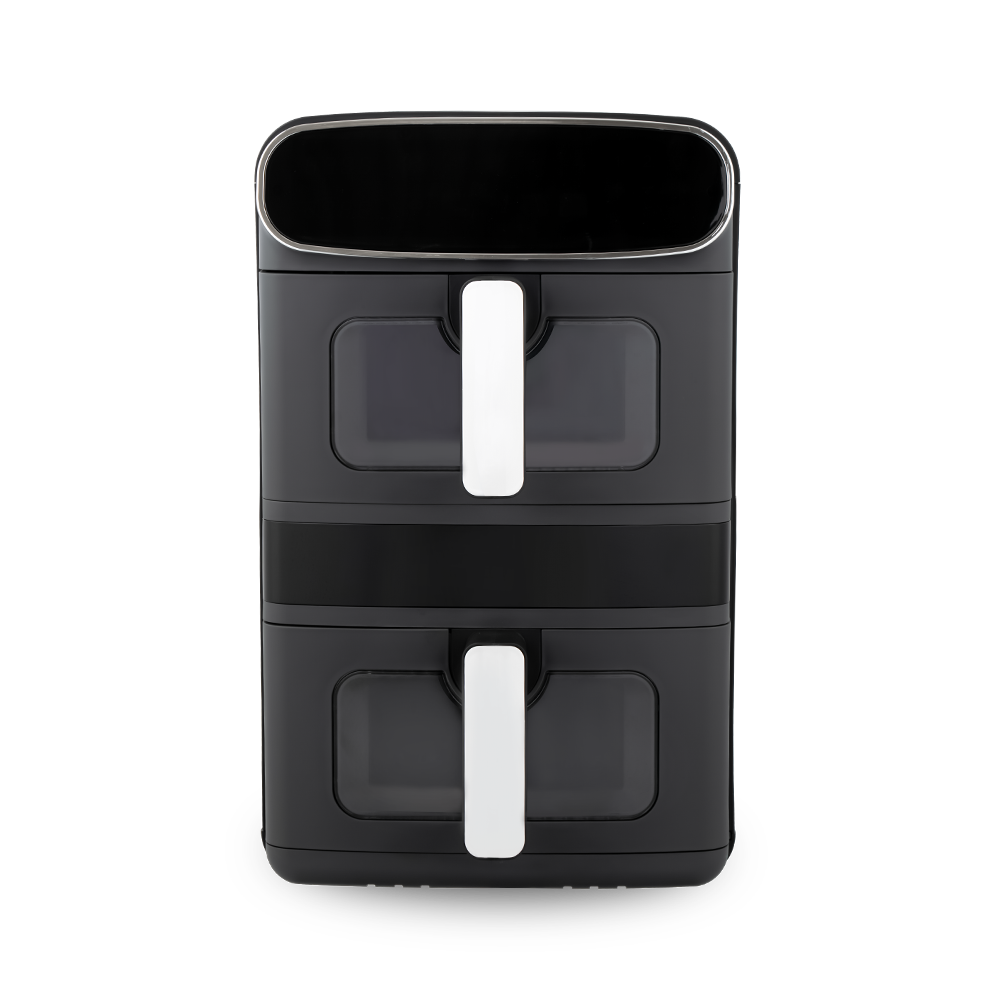
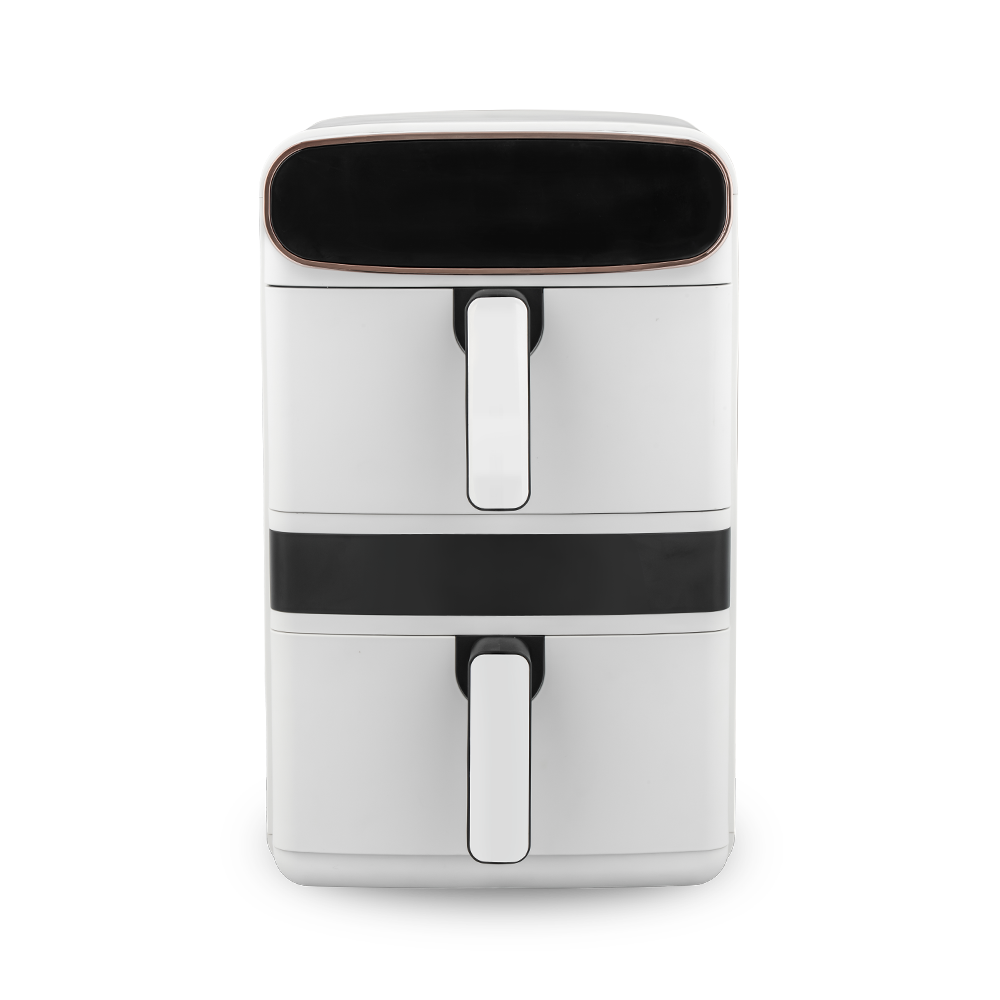
A double stacked air fryer is a two-zone air fryer arranged vertically: one basket drawer slides out below, and a second basket drawer sits above it. Each zone typically has its own temperature range, usually from 80°C to 200°C, and its own timer, so you can cook different foods at different settings simultaneously. The total capacity is the sum of both baskets, and most stacked models fall between 8 and 12 liters, with individual zones ranging from about 4 to 6 liters.
The stacked layout exists for one main reason: to double cooking capacity without doubling the counter space. A side-by-side dual-basket air fryer can exceed 60 cm in width, while a stacked unit usually stays within the width of a conventional single air fryer, around 30 to 40 cm. That difference matters in small kitchens, narrow counters, and any space where horizontal room is tight.
| Consideration | Stacked dual-basket | Side-by-side dual-basket |
|---|---|---|
| Counter footprint | Similar to a single air fryer; uses vertical space | Wider footprint; needs horizontal clearance of roughly 55–65 cm |
| Reaching the lower basket | Slides out below the upper zone; requires a short reach | Both drawers at counter level and easy to move |
| Heat isolation between zones | Depends on internal baffles and fan design; must be verified | Zones are physically separated from the start |
| Typical total capacity | 8–12 L split across two baskets | 8–12 L split across two baskets |
| Height clearance | Can be 40 cm or taller; check upper cabinet clearance | Lower profile; usually fits under standard cabinets |
Why Choose a Stacked Design?
For most households with limited counter space, a stacked double air fryer is the more practical of the two dual-zone layouts, provided the model separates the zones properly. The benefits are concrete:
- One footprint instead of two: you gain a second cooking zone without giving up counter length.
- Independent cooking: each zone runs at a different temperature and time, so a main dish and a side dish can finish when you want them to.
- Quicker results than cooking sequentially: two zones cut total cook time roughly in half compared with a single-basket unit.
- Flexible operation: run only one zone for small meals to save energy.
The limitations are equally worth knowing before purchase:
- The upper basket adds height; a stacked unit can reach 40 cm or more, which may not fit under low cabinets.
- The lower basket is less convenient to access, especially when the unit sits low on the counter.
- Fully loaded, two baskets plus food can feel heavy when sliding the lower drawer out.
- If the air duct between zones is poorly designed, the upper zone can overheat the lower zone or cause uneven browning.
Key Specifications That Separate Good Stacked Models from Mediocre Ones
Not every stacked unit performs the same way, and the differences are not obvious in product photos. Four specifications matter the most.
Motor and air delivery
The motor is the performance heart of any air fryer, and it matters even more in a stacked layout because one zone sits directly above the other. A DC motor delivers more consistent air circulation, quieter operation, and better energy efficiency than a conventional AC motor, and it holds temperature more steadily so both zones brown evenly. When a manufacturer specifies a DC motor in a double stacked air fryer, it is usually a sign that the unit was designed for regular multi-zone cooking rather than as a low-cost novelty.
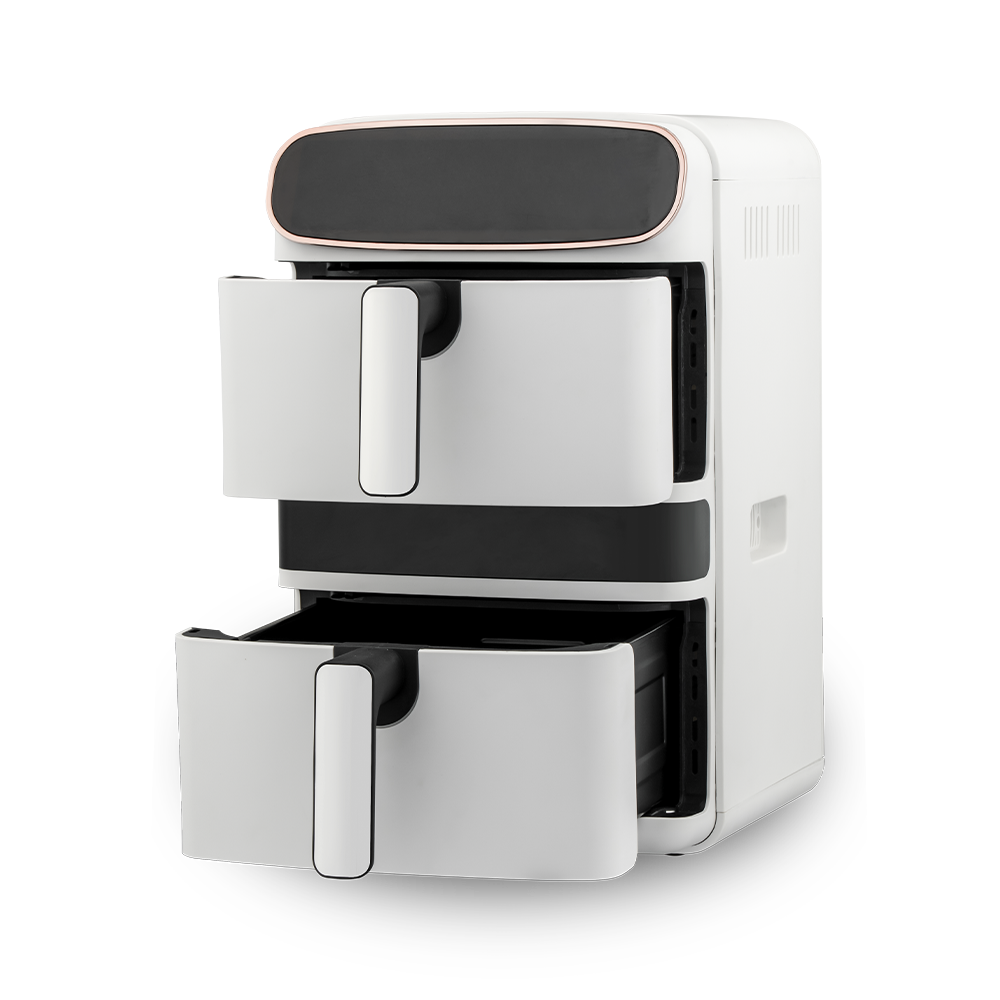 Stacked Air Fryer with High-Speed BLDC Motor and 12L CapacityThis stacked air fryer pairs a 12L capacity with a 3600-rpm DC motor for even, quiet cooking. Its enclosed design and independent temperature controls make it a practical choice for families cooking multiple zones regularly.View Product →
Control panel and zone management
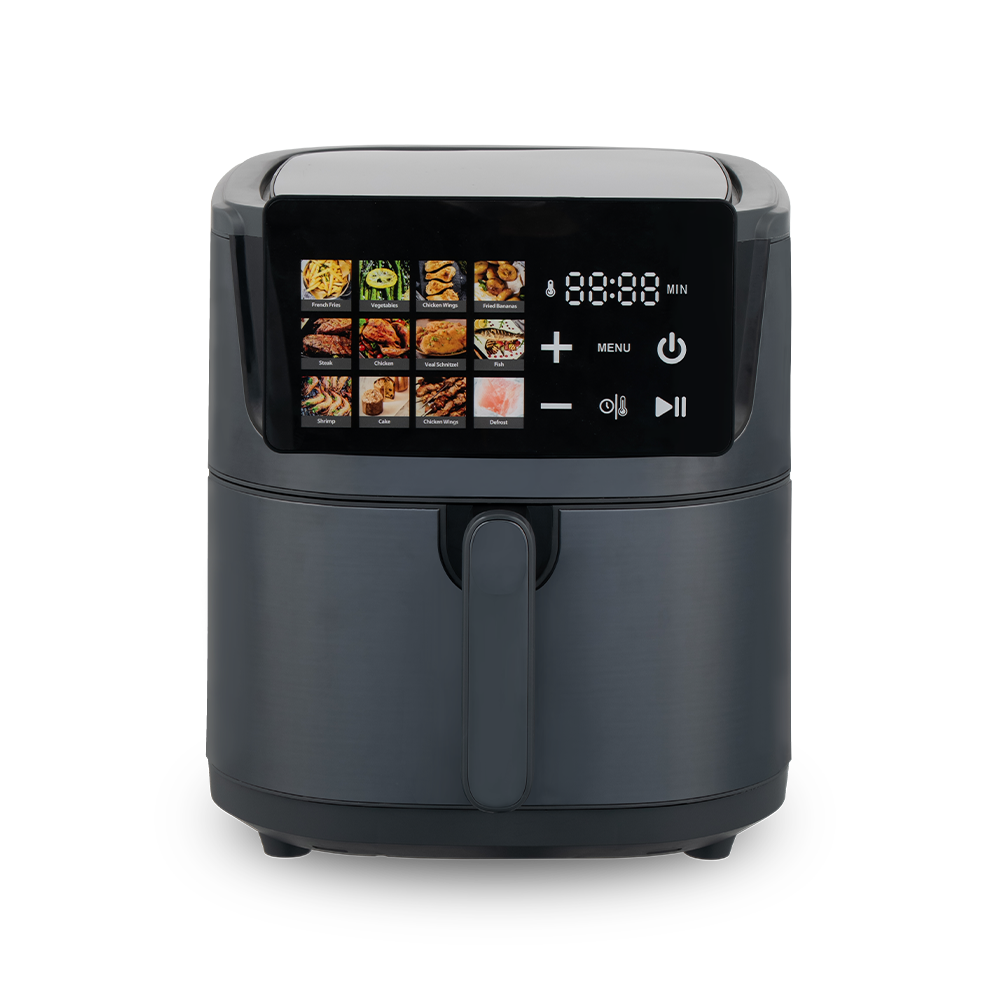
Stacked units use either a single shared panel or separate controls for each zone. Separate controls are the most straightforward option: you set the upper and lower drawers independently and move on. A shared panel works fine when the display clearly shows which zone is being adjusted, but it adds an extra step to every change. Digital touch screens with a two-zone readout are generally easier to interpret than mechanical knobs, especially when the unit sits higher on the counter, putting the panel at eye level.
Visibility and checking food
Opening a drawer mid-cycle releases heat and interrupts the cook, so visual feedback matters more in a stacked air fryer than in a single-basket model. Transparent baskets, glass fronts, or a viewing window let you check browning without pausing the cycle. This is especially valuable for the lower zone, which is less comfortable to pull out and push back repeatedly.
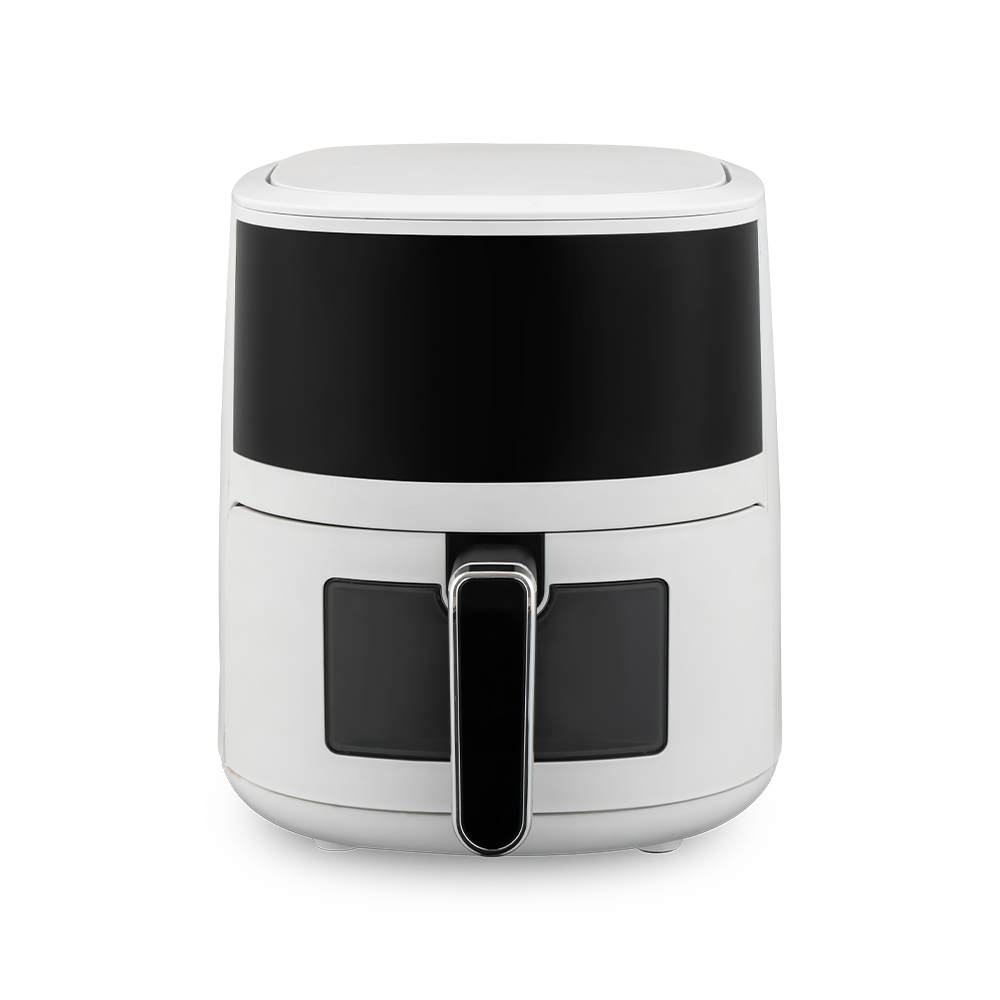
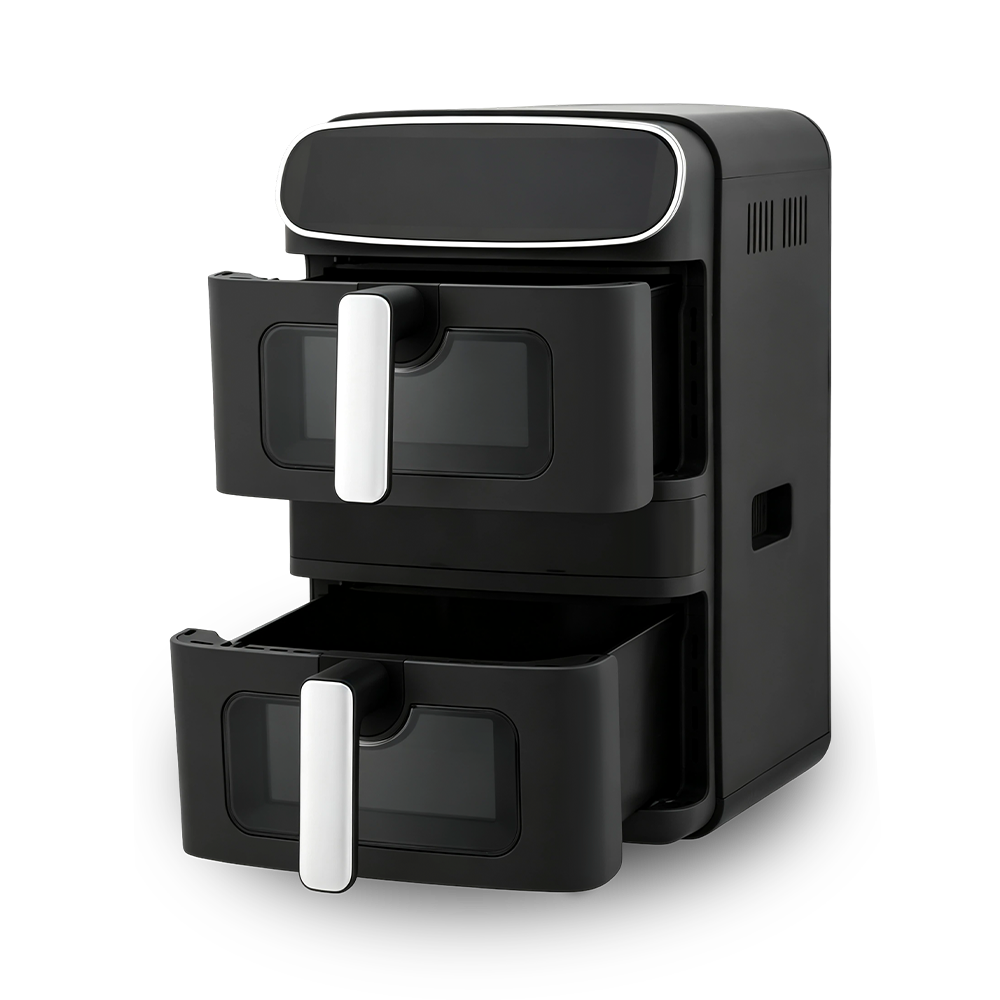 Dual-Zone Air Fryer with Transparent Baskets and BLDC MotorWith two 6L compartments and clear viewing windows, this stacked model lets you monitor browning without opening the drawer. A high-speed DC motor supports consistent results when cooking separate dishes at once.View Product →
Capacity per zone, not just total liters
Manufacturers often headline the combined capacity, but the number that matters is what each zone can actually hold. A 10-liter stacked unit usually means two 5-liter baskets, yet usable volume is lower after you account for the basket insert, airflow channels, and heating element clearance. As a rough reference, a 4-liter zone holds about 0.9 kg of chicken wings in a single layer, and a 5-liter zone holds roughly 1.2 kg. If you cook for four or more people on a regular basis, look for at least 5 liters per zone.
Matching Capacity to Household Size
A practical way to choose capacity is to match it to the largest meal you cook in a normal week, not the average meal. Weekday dinners, weekend gatherings, and batch meal prep all place different demands on the baskets.
| Household size | Typical meal pattern | Recommended total capacity | Per-zone minimum |
|---|---|---|---|
| 1–2 people | Snacks, frozen foods, small proteins | 6–8 L | 3–4 L |
| 3–4 people | Full dinners, meat plus vegetables | 8–10 L | 4–5 L |
| 5+ people or meal prep | Batch cooking, reheating leftovers | 10–12 L | 5–6 L |
If your household falls into two different patterns at different times, such as cooking for two during the week and for six on Sundays, size the unit for the larger occasion. You can always run one zone at a time, but you cannot make a small basket bigger.
What to Verify Before Buying
Before you settle on a model, add these checks to your list:
- Basket materials: food-contact grade stainless steel or PFOA-free nonstick coating that withstands repeated high-heat cycles.
- Drawer rails: full-extension rails that stay stable when the basket is loaded; a wobbly drawer is both a safety and a durability concern.
- Safety certifications: look for CE, RoHS, and market-specific marks such as UL or ETL; a manufacturer with ISO 9001:2025-rated production lines usually documents these more thoroughly.
- Rated power and circuit load: a high-wattage stacked unit may need a dedicated kitchen circuit; check the cord length and plug type for your region.
- Spare parts and service: two heating elements and two fans mean more components to replace over time, so confirm that spare parts are available.
Seeing specifications side by side makes the comparison easier. We keep a current index of our dual air fryer lineup with per-zone capacities and dimension drawings, so you can check your bench clearance before deciding.
Buying from a Manufacturer: What Changes
For retailers, importers, and brand owners, the stacked format has a practical advantage: it falls into the same regulatory category as a conventional air fryer, so no special approval path is needed. But the stacked structure does increase the number of moving parts (two baskets, two heating elements, two fans), which means more potential failure points. A factory with a complete quality control flow, from incoming component inspection to whole-unit testing, makes a measurable difference in out-of-box failure rates and long-term reliability.
When you evaluate a supplier, ask specific questions: Which motor is used and what is its rated lifespan? How is the gap between zones sealed to prevent hot air leaking from one zone to the other? What is the minimum order quantity for a custom color, finish, or control interface? For reference, the design decisions we made when we launched our dual-basket smart air fryer were published in our launch notes, including zone separation and motor selection, which gives buyers a practical benchmark for comparing other factories.
The Bottom Line
A double stacked air fryer earns its place on a countertop when horizontal space is limited and you regularly cook two things at once. Choose a model with a DC motor, at least 4 to 5 liters per zone, independent controls, and a way to see the food while it cooks. Skip the stacked design if you usually cook for one or two, or if your counter has generous width and you prefer the reach of side-by-side drawers. With the right specifications, a double stacked air fryer is a genuine time-saver; with weak airflow or cramped baskets, it is simply twice the frustration.